A concrete heavy debris dumpster rental differs fundamentally from standard household trash containers because inert masonry materials reach DOT highway weight thresholds long before filling the container's physical…
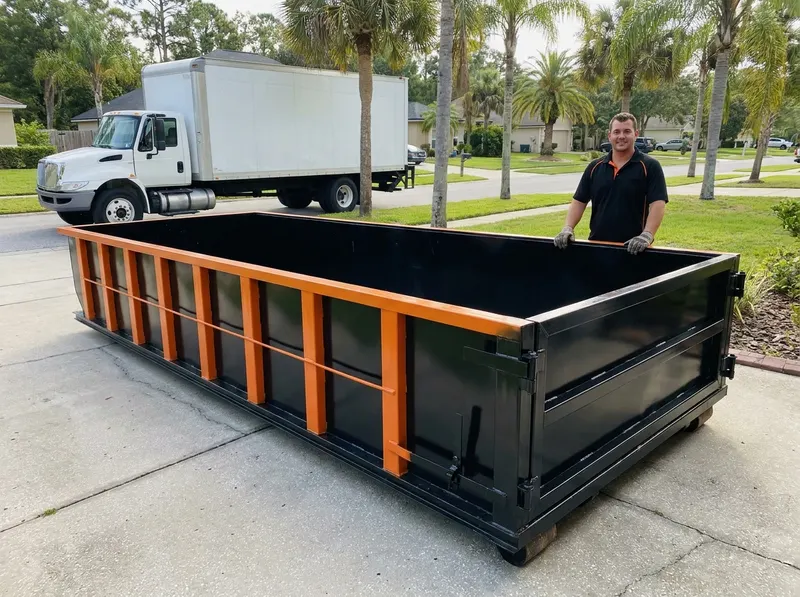
A concrete heavy debris dumpster rental differs fundamentally from standard household trash containers because inert masonry materials reach DOT highway weight thresholds long before filling the container's physical volume. A single cubic yard of solid concrete weighs roughly 4,050 pounds, meaning a standard 10-yard container half-filled with foundation rubble quickly reaches 10 tons. For patio tear-outs in historic Riverside or sidewalk removals in Avondale, selecting a dedicated 10-yard container at $595 provides a compact footprint for tight driveways while maintaining lawful road-haul weights. If a job involves an entire driveway replacement or large retaining wall demolition in Mandarin or Southside, stepping up to a 20-yard container at $695 allows wider swing-door access for bobcat or wheelbarrow loading, though haulers enforce a strict low-fill waterline to prevent trucks from exceeding Florida Department of Transportation axle limits.
Surface protection remains a standard operational practice on every residential and commercial property. Heavy debris roll-off trucks exert substantial downward force during drop-off and retrieval, creating risk for cracked concrete slabs, gouged asphalt, or crushed decorative pavers along properties in San Marco and Ortega. Drivers place heavy-duty wooden protective runners beneath the steel container rollers before lowering the bin, distributing load weight evenly across the surface. This mechanical buffer isolates the ground from direct metal contact, protecting residential driveways against surface fracture. Placement requires a level, firm surface clear of low-hanging live oak limbs and overhead utility lines, leaving roughly 60 feet of straight-line clearance for the transport vehicle to reverse and tilt its bed.
Scheduling inert debris removal demands strict adherence to material purity guidelines enforced by regional aggregate processing plants near the Northside and Oceanway. Clean masonry, brick, gravel, and unpainted foundation chunks are diverted away from the Trail Ridge Landfill and hauled directly to crushing yards to be ground into road base aggregate. Mixing standard municipal solid waste, pressure-treated lumber, drywall, or roofing shingles into a dedicated masonry bin contaminates the load, forcing facilities to reclassify the container as mixed construction debris at higher disposal gates. For continuous commercial site work along Arlington or near Fort Caroline, contractors schedule swap-outs where a filled bin is hoisted and an empty replacement is lowered in a single trip, keeping excavation machinery operating without debris bottlenecks.
Every job gets a firm, written price after a free on-site visit.
Tell us about your concrete heavy debris dumpster job in Jacksonville and we'll send a clear, written quote, usually the same day.
 Meadow Creek Dumpster Rental